Assignment 6 of 6
DISC deepening
The certified DISC training at Q4 Profiles, my profile, and what it changes in how I work with my group.
Pre-survey done on 17 September: my profile is the Strategist (Cd). Training day on 22 September at Q4 Profiles.

The brief
Follow the certified DISC training at Q4 Profiles. Describe my DISC profile with practical examples, show where I recognised my behavioural preference in group dynamics, and set one improvement point for cooperation in my project group with a concrete action plan.
- Certified training at Q4 Profiles on 22 September
- My profile, described with practical examples
- Examples of my style in group dynamics
- One improvement point with a concrete action plan
My approach
- 1
Fill in the survey honestly
The pre-survey is the base of the whole day. I answered how I actually behave in my group, not how I would like to. It came out as the Strategist: mostly C, with some D.
- 2
Spot it in the room
After the training I watch two group meetings with the four styles in mind and write down three moments where my own preference showed.
- 3
One improvement point, agreed with the group
My profile says I avoid conflict and push back quietly when I think a plan is pointless. So my point is to say disagreement out loud, in the meeting. Not a private resolution: agreed with the group, with a check-in four weeks later.
My profile
The Strategist (Cd)
Q4 Profiles places me as a Strategist: a free thinker who wants to find better ways of doing things, and wants them precise and complete. I focus more on processes than on people. These are the four parts I recognise, each with a moment from my own life.
I prefer to work alone
You prefer to work alone and involve as few other people as possible.
When I work alone, I am responsible for the result, so I make sure it is good. In groups, work sometimes comes in late or isn't good enough. That doesn't mean I don't want to work with others: with people I trust I go faster than when I have to figure everything out by myself.
I want it precise and complete
It comes naturally to you to ensure everything is checked properly to prevent mistakes and failures.
When I see something that isn't good, I fix it myself instead of waiting for someone else to do it. Then I know it is good.
I turn ideas into processes
You think big when it comes to improvements and innovations, and you can translate this into processes.
I was paying for speech-to-text software until I worked out how to build it myself. Now the tool is mine and I save 15 euros a month.
I push back quietly
When faced with changes or objectives you consider pointless, you counteract in a subtle way.
In last year's group work I sometimes thought: this could be done better, or this is the wrong way to think about it. I didn't feel comfortable saying it out loud. That is why this became my improvement point.
Evidence
2 of 5 added
DISC profile report (added)
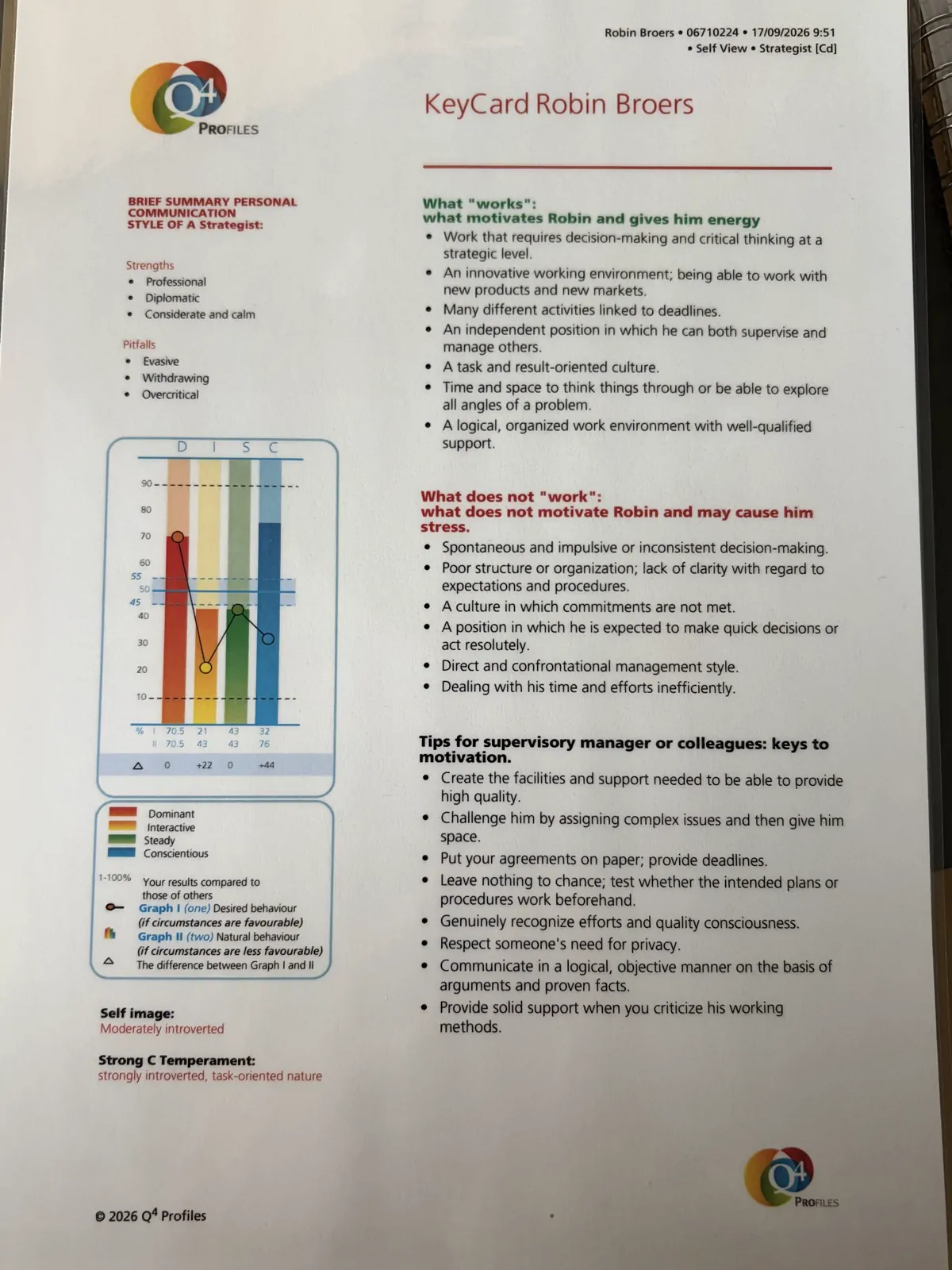
Strategist (Cd), self view, 17 September. A free, critical thinker who turns ideas into processes, wants work precise and complete, prefers to work alone and avoids conflict.
AddedProof of participation (added)
My KeyCard from the Q4 Profiles training: the Strategist (Cd) profile on one page, with the D-I-S-C graph of my desired and my natural behaviour.
 Open largerAdded
Three moments from group meetings (to add)
Where my style showed, and what it did to the meeting.
Expected OctoberImprovement point and action plan (to add)
Agreed with the group, with a date for the check-in.
Expected OctoberCheck-in after four weeks (to add)
Did the agreement hold? What changed?
Expected November
Reflection
Reflection tool: STARR
Written after the four-week check-in.
Situation, Task, Action, Result, Reflection. The improvement point is a small project of its own.
- 1Situation: my profile, and the moments in the group where it showed.
- 2Task: the improvement point we agreed on, and why that one.
- 3Action: what I did differently in meetings, week by week.
- 4Result: what the group noticed, and what the check-in said.
- 5Reflection: which part of my style helps the team, and which part I need to manage.