Assignment 2 of 6
Presenting, before and after
Eight minutes on the VOC, filmed twice, with a presentation workshop in between.
Topic chosen: the VOC, the Dutch East India Company. First attempt on Tuesday 6 October, second attempt on Monday 19 October. The slides for the first attempt are done.

The brief
Give a presentation of at most eight minutes on a topic I choose, supported by slides. It is filmed. I get peer and teacher feedback, follow a workshop on presentation techniques, adapt the presentation, and give it a second time. The reflection uses a reflection tool such as Gibbs.
- At most 8 minutes, own topic, with slides
- Filmed, with peer and teacher feedback
- Presentation-skills workshop in between
- Second attempt with the improvements
- Reflection with Gibbs or a similar tool
My approach
- 1
Pick a topic nobody in the room knows
I brainstormed with AI about what I actually care about and history kept coming back. So the topic is the VOC, the Dutch East India Company. Almost nobody in my class is from the Netherlands, so this is a piece of my country's history they have never heard, and it is a story I don't need notes for.
- 2
Two centuries into eight minutes
The VOC ran for almost two hundred years, so the hard part is leaving things out. One thread, three or four moments, and the rest goes. What stays is what an audience with no Dutch background can follow.
- 3
Prepare a week ahead, not on the day
Last year I made the Kahoot on the day of the workshop. Not again. Slides finished and the talk rehearsed out loud a week before the first attempt.
- 4
First attempt, then watch it back
Film it, collect the peer forms and the teacher's notes the same day, and watch the recording that evening. Uncomfortable, but that is where the learning is. I note three things to fix.
- 5
Workshop, then rebuild
Apply the presentation-techniques workshop to those three things. Change the slides only where they get in the way of the delivery.
- 6
Second attempt, side by side
Same topic, better delivery. Put the two recordings next to each other and cut a short compilation of the parts I reflect on.
Evidence
1 of 5 added
Slides, version 1 (added)
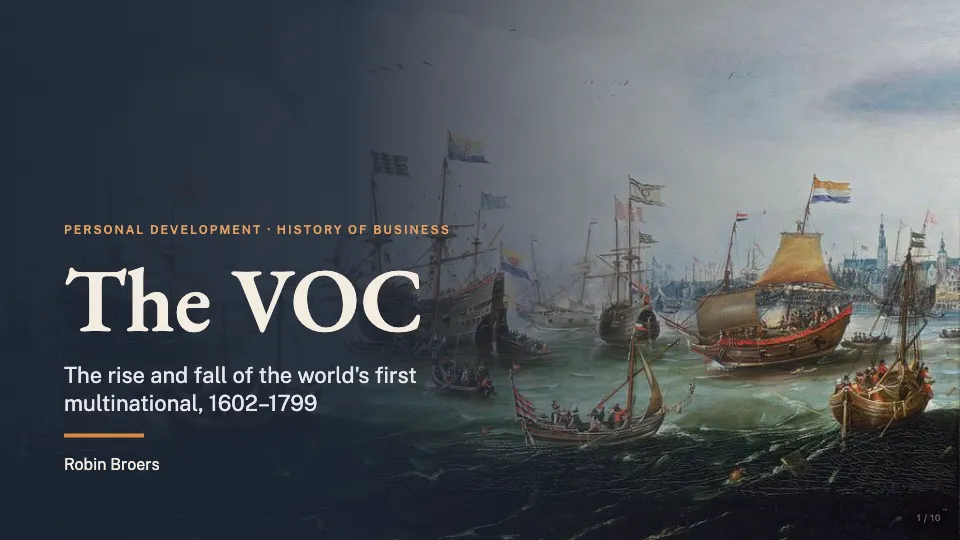
The deck for the first attempt: ten slides on the rise and fall of the VOC, from the rival fleets of 1595 to the end in 1799.
 Open the slides
Recording, first attempt (to add)
A compilation of the parts I reflect on, not the full eight minutes.
Expected after 6 OctFeedback, first attempt (to add)
Peer forms and the teacher's notes.
Expected after 6 OctSlides, version 2 (to add)
What changed after the workshop, and why.
Expected before 19 OctRecording, second attempt (to add)
The same parts, so the difference is visible.
Expected after 19 Oct
Reflection
Reflection tool: Gibbs reflective cycle
Written after the second attempt on 19 October.
Six steps. It forces me to look at how I felt, not only at the slides.
- 1Description: what happened in both attempts.
- 2Feelings: what I felt before, during and after, both times.
- 3Evaluation: what went well and what did not, using the feedback and the recordings.
- 4Analysis: why it went that way, and what the workshop changed.
- 5Conclusion: what I would do differently with a third attempt.
- 6Action plan: what I do before the assessment presentation in January.
The VOC in six moments
Not part of the assignment, just the story I am telling. If you want the eight-minute version in two minutes, scroll.
1595
1595
Before there was a company
Spices from Asia reached the Netherlands through Lisbon, until the Portuguese route closed to Dutch traders. So Amsterdam merchants sent their own ships. Cornelis de Houtman's first voyage to Java took two years and lost most of its crew, but it came back with pepper and proved the route. Within five years a dozen small rival companies were racing each other to the Indies, bidding up prices there and crashing them at home.
- First Dutch voyage to the East Indies, 1595 to 1597
- Around a dozen competing 'pre-companies' by 1601
1602
1602
One charter, one company
On 20 March 1602 the States-General merged the rivals into one company and gave it a monopoly on all Dutch trade east of the Cape of Good Hope. The charter let the VOC sign treaties, build forts and keep an army. Anyone could buy a share, and thousands did, which is why it is often called the first publicly traded company in the world.
- Six chambers, run by the 'Heren XVII'
- Roughly 6.4 million guilders raised from the public
- Charter valid for 21 years, renewed for nearly 200
1619
1619
From trading posts to an empire
Jan Pieterszoon Coen founded Batavia, today's Jakarta, as the company's headquarters in Asia. From there the VOC took Banda, Malacca, Ceylon and the Cape, and became the only European power allowed to trade with Japan. This is also the darkest chapter: the nutmeg monopoly on Banda was won by killing or enslaving most of the islands' population, and the company traded in enslaved people for the rest of its life.
- Batavia 1619, Banda 1621, Malacca 1641
- Dejima, Japan, from 1641
- Cape of Good Hope settled 1652
1670
1670
The richest company on earth
At its peak the VOC was bigger than some countries. Its fleet was larger than the English and Portuguese fleets combined, Amsterdam had become the trading capital of Europe, and the company paid its shareholders dividends that modern investors would not believe.
- About 150 merchant ships and 40 warships
- Around 50,000 employees and 10,000 soldiers
- Dividends of up to 40 percent a year
1700s
1700s
Slow decline
Spices stopped being where the money was. Tea, coffee and cotton took over, and the British East India Company did those better. Costs went up, profits went down, and the company kept paying dividends it could not afford. The nickname of the era says it all: Vergaan Onder Corruptie, 'perished under corruption'.
- Fourth Anglo-Dutch War, 1780 to 1784, wrecked the fleet
- Debts of more than 100 million guilders by the 1790s
1799
1799
The end
In 1796 the new Batavian Republic took over the company's management, and on 31 December 1799 the charter was simply allowed to run out. The state inherited the debts and the territories. The territories became the Dutch East Indies, which stayed a colony until Indonesia's independence in 1945.
- Nationalised 1 March 1796
- Dissolved 31 December 1799
- Almost 200 years, about 4,700 voyages, nearly one million people shipped to Asia
Two hundred years, six moments. That is the cut I have to make for eight minutes.